For Honor's Sake (part I)
It takes a Honor to raise a child

State of the Honor: 2025
1If you're not under a WiFi-jammed rock, you've probably been following the middle east go up in flames, yet again.
On the right corners of the internet you get a lot of this2:

Humiliation is where it's at. Winning isn't the point - it isn't even well defined (Hamas, Iran etc. always win no matter tattered reality).
Here's Fathi Hamad, Hamas’ prior minister of interior - a professional of his trade by all accounts - with a guide on how to humiliate Jews for 5 Shekels (listen to his words: killing, apparently, isin’t the point)3:
Pretty dark. On the bright side though, people start remembering that different people are actually different4. Tribalism isn’t ‘just’ a metaphor. Beyond the egalitarian West the world tends to put a different weight on Honor and it's loss via humiliation.
Summarizing past two years: Honor stocks are up. Ok; it was worth it.
But beyond the middle east, Honor isn’t much talked about these days. It’s more a relic of the past, something that we hear tossed around when Homeric Greece is under discussion, or during Sunday School's ‘honor thy father’, but not anything that is seen as useful or relevant.
So I want to discuss what happened to honor, where it went, should we bring it back, and its effects on culture, ethics, and our understanding of the past. All things Honor.
Part I (you are here):
Suicide
Ramban on 10C’s
Part II (next time):
Ethics
Skinned Walruses
Rav Hunter's Honor
More texts
Conclusion
1. Suicide
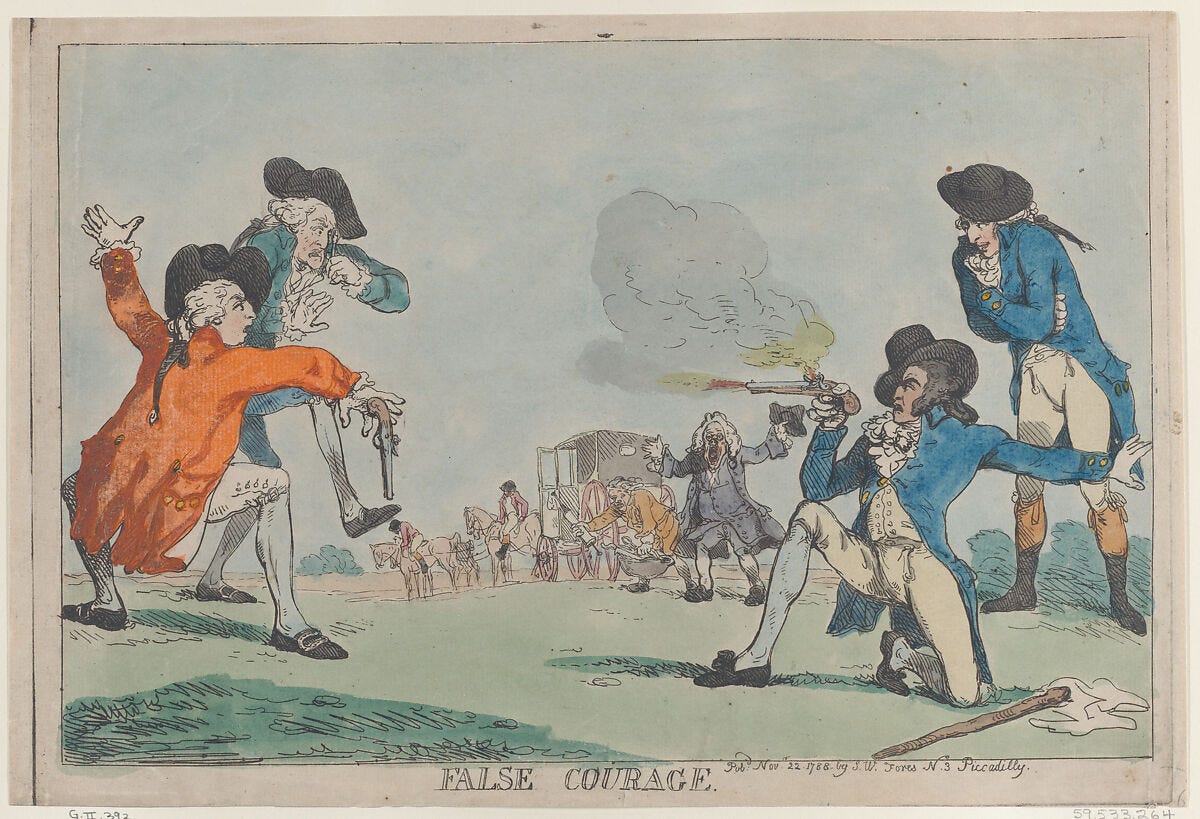
Évariste Galois (pronounced gal'wa), was a French mathematician who, already in his teens, laid the groundwork for Galois theory and group theory. It had to be so. He was killed in a duel at 20. The catalyst is unclear, perhaps over the hand of an unaccounted Stéphanie D., but what is clear is that Galois knew his fate. He spent his last night writing farewells to his Republican friends - it was the height of the July Revolution5 - and setting down his mathematical ideas. He was proven correct. Shot on the morning of May 30, 1832, he died shortly after in Parisian hospital, his grave unknown.
Whatever the duel’s motives, the driving force was honor. As per custom, following the honor code of the time, disgraced honor could only be redeemed through a duel. This “duelomania” was common, often fatal, and therefore strictly forbidden by Napoleon and French law of the time6.

Now think about it: not long ago, men were willing to die on the altar of personal honor - not for freedom on the ancestral cornfield or for the state on some faraway battlefield, but for private personal honor7. Today, claiming ‘honor damages’ in court without monetary loss would be laughable. ‘Man up’ you’d be told. What changed?
Peter Berger raises this in his excellent8 ‘On the obsolescence of the concept of honor’:
The obsolescence of the concept of honor is revealed very sharply in the inability of most contemporaries to understand insult, which in essence is an assault on honor. In this, at least in America, there is a close parallel between modern consciousness and modern law. […] In modern consciousness, as in American law (shaped more than any other by that prime force of modernization which is capitalism), insult in itself is not actionable, is not recognized as a real injury. […] In other words, the reality of the offense will be denied.
So honor was on the path to obsolescence in the past 400 years. But Berger argues it is a mistake to view past centuries as a one-directional move away from honor, that would only be half the picture. Honor was fading, even as dignity - human dignity - was on the rise:
The age that saw the decline of honor also saw the rise of new moralities and of a new humanism, and most specifically of a historically unprecedented concern for the dignity and the rights of the individual. The same modern men who fail to understand an issue of honor are immediately disposed to concede the demands for dignity and for equal rights by almost every new group that makes them-racial or religious minorities, exploited classes, the poor, the deviant, and so on.
So, it wasn’t that modernity brought a coarsening of the human sentiment which saw less value in fighting over honor. Rather, the center-of-gravity shifted from valuing honor (status earned through community and social roles) to valuing dignity (the intrinsic value of human qua human).
This wasn’t by chance either. The fall of honor and rise of dignity were intertwined, one coming at the expense of the other. What changed was our idea of Ideal Man. During the Age of Honor, he was the man who climbed to (or was born into) the higher ranks of the social ladder: a knight regaled in armor, galloping out on a white horse to battle. In a post-Honor world, man has value not for who he became, but for who he always was. Cloaking yourself in regalia wasn’t applauded as embracing your arrived-at value but a move of hiding one’s true self.
Berger again:
The modern discovery of dignity took place precisely amid the wreckage of debunked conceptions of honor. […] Dignity as against honor always relates to the intrinsic humanity divested of all socially imposed roles or norms. It pertains to the self as such, to the individual regardless of his position in society.
[…]
The concept of honor implies that identity is essentially, or at least importantly, linked to institutional roles. The modern concept of dignity, by contrast, implies that identity is essentially independent of institutional roles. […] The true self of the knight is revealed as he rides out to do battle in the full regalia of his role; by comparison, the naked man in bed with a woman represents a lesser reality of the self. In a world of dignity, in the modern sense, the social symbolism governing the interaction of men is a disguise. […] It is precisely the naked man, and even more specifically the naked man expressing his sexuality, who represents himself more truthfully. Consequently, the understanding of self-discovery and self-mystification is reversed as between these two worlds. In a world of honor, the individual discovers his true identity in his roles, and to turn away from the roles is to turn away from himself-in ‘false consciousness,’ one is tempted to add. In a world of dignity, the individual can only discover his true identity by emancipating himself from his socially imposed roles-the latter are only masks, entangling him in illusion, ‘alienation’ and ‘bad faith.’9
Apparently, a strange shift has occurred in the past 500+ years of Western humanity via the role of honor - a shift in what being human meant, per individual and per his place within society10.
As I hope to show, understanding how honor works, the place it holds, and its relationship to institutions is relevant in more than one way to how modern society sees itself and functions.
But what does honor do?
2. Ramban on 10C’s
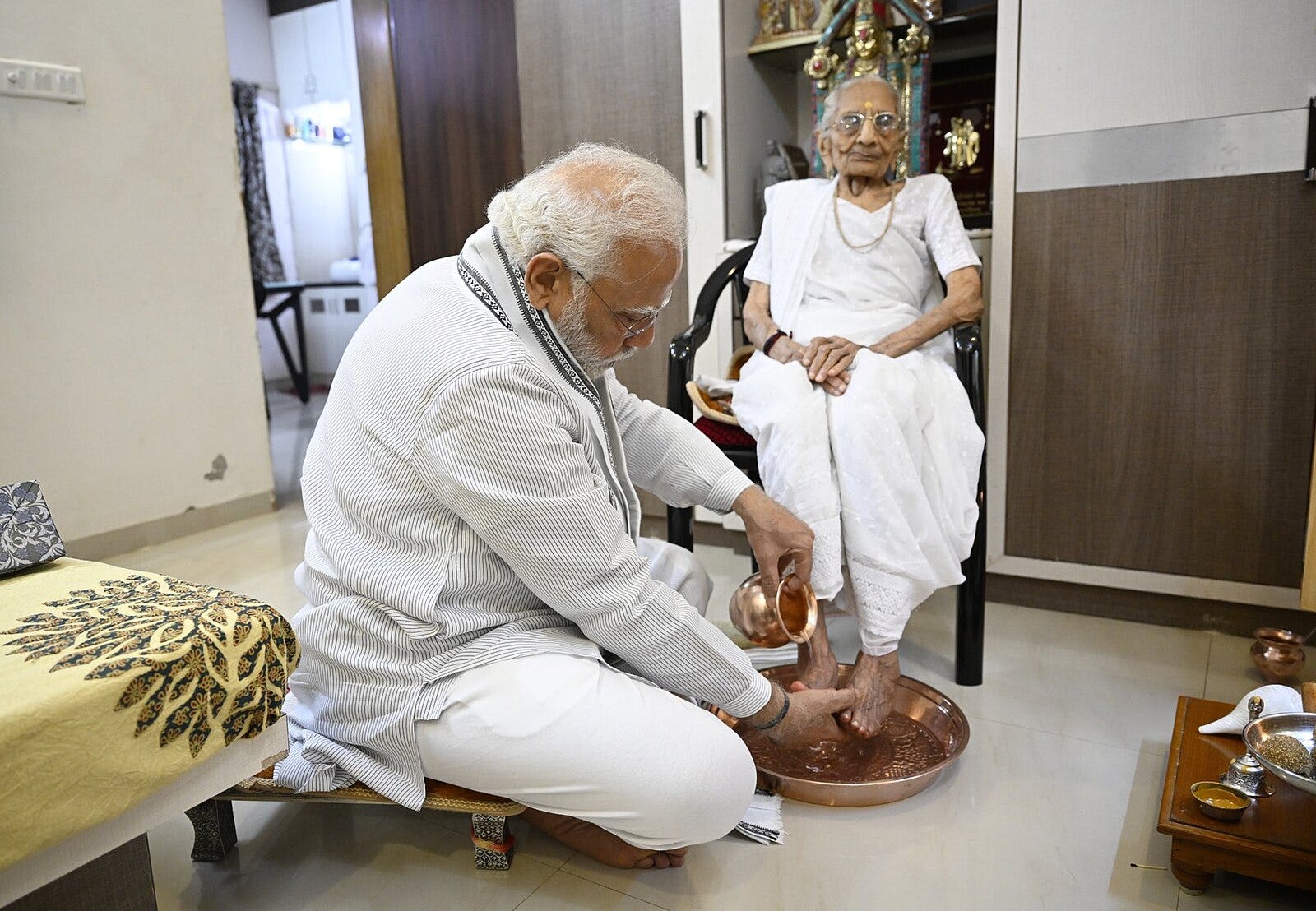
The biblical ‘Ten Commandments’ are traditionally divided in two: the first five relating to C's between G-d and Man, the latter five C's between Man and Man (yes, Man means people today). It's a beautiful distinction, except that it doesn’t hold: The fifth commandment ‘Honor thy father and thy mother’ (hereon The Fifth) is Man to Man, commanding that children honor and respect their parents, so why is it in the first five?
Ramban (Catalonia, 1194–1270) comments:
הנה השלים כל מה שאנו חייבין בדברי הבורא בעצמו ובכבודו וחזר לצוות אותנו בעניני הנבראים והתחיל מן האב שהוא לתולדותיו כענין בורא משתתף ביצירה כי השם אבינו הראשון והמוליד אבינו האחרון ולכך אמר במשנה תורה (דברים ה טז) כאשר צויתיך בכבודי כן אנכי מצוך בכבוד המשתתף עמי ביצירתך
So honoring one’s parent is a derivative of honoring G-d and therefore this commandment is in some ways indeed G-d to man.
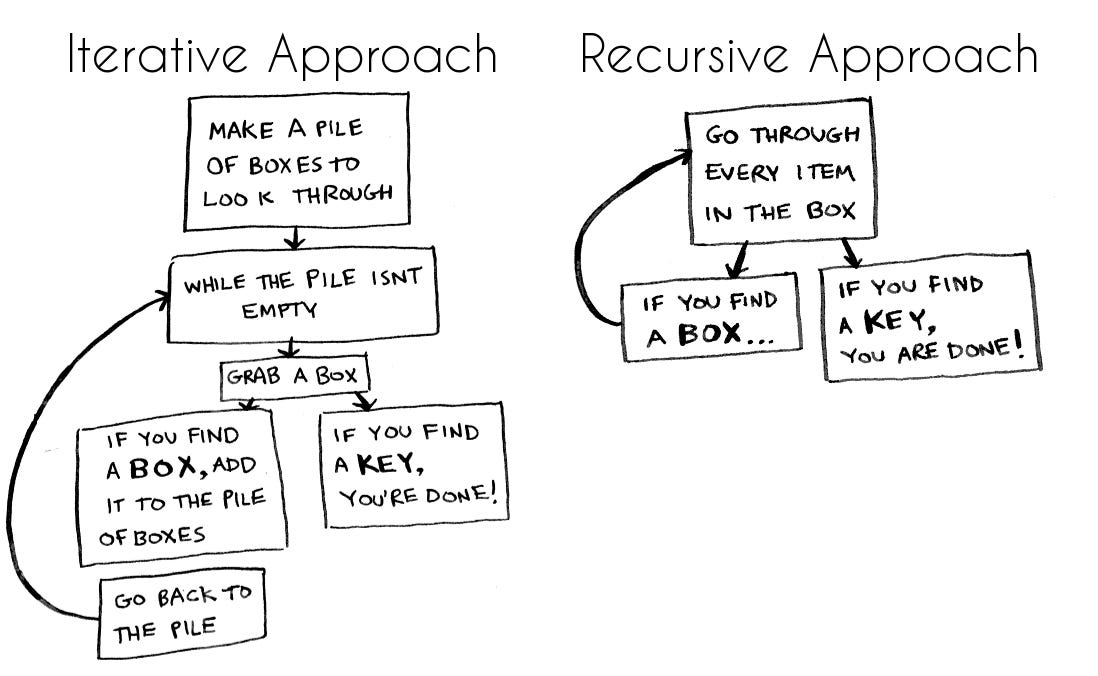
Notwithstanding Ramban’s interpretation, I’d like to suggest the following: The Fifth must be read and understood recursively11. Meaning, it can only be made sense of when applied repetitively across generations, reflecting on the type of society it forms in its wake, birds-eye view. The classic view focuses on the family unit: respect and care for your parents. Recursion reveals a wider social design.
Recursion is the process where a rule is applied over and over until ‘order’ or a ‘solution’ is reached. Applying The Fifth recursively: if Bobby, Brian, and Betty must honor their parents Adam and Ava, and all of Bobby’s, Brian’s, and Betty’s children - Claire, Charlie, Chris, Cora, and Chloe - must honor them in turn, iterate 10X and society takes on a triangular form, with honor flowing upward:
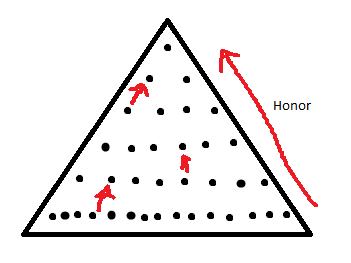
Again, the Fifth is trying to create a certain type of society. Our modern, equality-striving, anti-clerical, anti-hierarchical society, where governments are toppled by the (anonymous, online, apparently-Discord-savvy) masses is very different from the world where dynasties and castes were kept in place for hundreds of years. Yes, this isn’t all positive sounding, and yet, certain elements of that world allow for options which we are now barred from.
So we discussed honor, it’s rise and fall, and how it fundamentally shapes and reshapes society in it’s wake.
This is where Honor somehow bleeds into ethics - specifically, the type of ethics we are allowed to have. Proven again: Everything is related to everything else.
To be continued…
The Cover photo is of Gandan Monestary, on the outskirts of Ulaanbaatar, Mongolia. It’s from 1913, and of original color. What I find beautiful is the way it captures the values of the Mongolian-Buddhist society - rundown dilapedated shacks next to a collosal structure, of religious importance, spotted from miles away.
Or this - on ‘Nasrallah’s Culture of Life’ (0:28 onward):
Though I’d happily point out that we shouldn’t over-apply honor motivations where Occam's razor would ask for narcissism and fear etc. more here:
In order for this to be an honor killing in the traditional sense--note the words honor and traditional--the purpose of the killing has to be to remove shame from the family. In this logic, an honor killing is not simply punitive but a selfless act, because it puts the murderer at risk of punishment (and grief) so that his descendants may live with honor. It is for the sons so that they can grow up and marry without carrying the shame of their mother or sister’s actions; for the surviving daughters so they won’t be thought of as whores like their sister.
So this would make perfect sense:
Prosecutors said the defendants killed the three teenage sisters because they felt they had dishonoured the family by defying its strict rules on dress, dating, socialising and using the internet.
The problem is that this isn’t why the women were killed, it is the post-hoc rationalization for why they were killed.
And here.
I hear Japan in the new Dharamshala, where many come back with similar observations.
A day before this:
Though Missouri would like to reinstate it:
If a senator's honor is impugned by another senator to the point that it is beyond repair and in order for the offended senator to gain satisfaction, such senator may rectify the perceived insult to the senator's honor by challenging the offending senator to a duel.
Very creative.
McIntyre in After Virtue:
It is important to notice that the concept of honor in the society for which Aristotle was the spokesman--and in many subsequent societies as different as that of the Icelandic sagas and of the Bedouin of the Western desert--just because honor and worth were connected in the way which Aristotle remarks, was-in spite of the resemblance-a very different concept […] from almost anything that we find in modern societies. In many pre-modern societies a man’s honor is what is due to him and to his kin and his household by reason of their having their due place in the social order. To dishonor someone is to fail to acknowledge what is thus due. Hence the concept of an insult becomes a socially crucial one and in many such societies a certain kind of insult merits death. Peter Berger and his co-authors (1973) have pointed out the significance of the fact that in modern societies we have neither legal nor quasi-legal recourse if we are insulted. Insults have been displaced to the margins of our cultural life where they are expressive of private emotions rather than public conflicts.
Excellent - in the sense that no words go to waste. He writes, not to say something, but to deliver a point.
And, Berger continues, this attitude results in a different relationship towards history:
It follows that the two worlds have a different relation to history. It is through the performance of institutional roles that the individual participates in history, not only the history of the particular institution but that of his society as a whole. It is precisely for this reason that modern consciousness, in its conception of the self, tends toward a curious ahistoricity. In a world of honor, identity is firmly linked to the past through the reiterated performance of prototypical acts. In a world of dignity, history is the succession of mystifications from which the individual must free himself to attain ‘authenticity.’
Such that:
[I]n 1915, a club owner was brought before court after “insulting fellow hotel patrons” with snarky, self-assured remarks. The Police Magistrate proceeded to fine the man $25 for being a “smart Alec.”
For those who missed CS101: